
SQL Topic
Database Design & Normalization
Good database design ensures data is organized, consistent, efficient, and scalable.
This involves modeling entities, defining relationships, applying normal forms, and knowing when to denormalize.
1. Data Modeling & ER Diagrams
Data modeling begins with identifying entities, their attributes, and the relationships between them.
Common Entity Examples
-
Customers
-
Orders
-
Products
-
Employees
-
Departments
-
Payments
Relationship Types
| Type | Example |
|---|---|
| One-to-Many | Customer → Orders |
| Many-to-Many | Order ↔ Products (via order_items) |
| One-to-One | User → Profile |
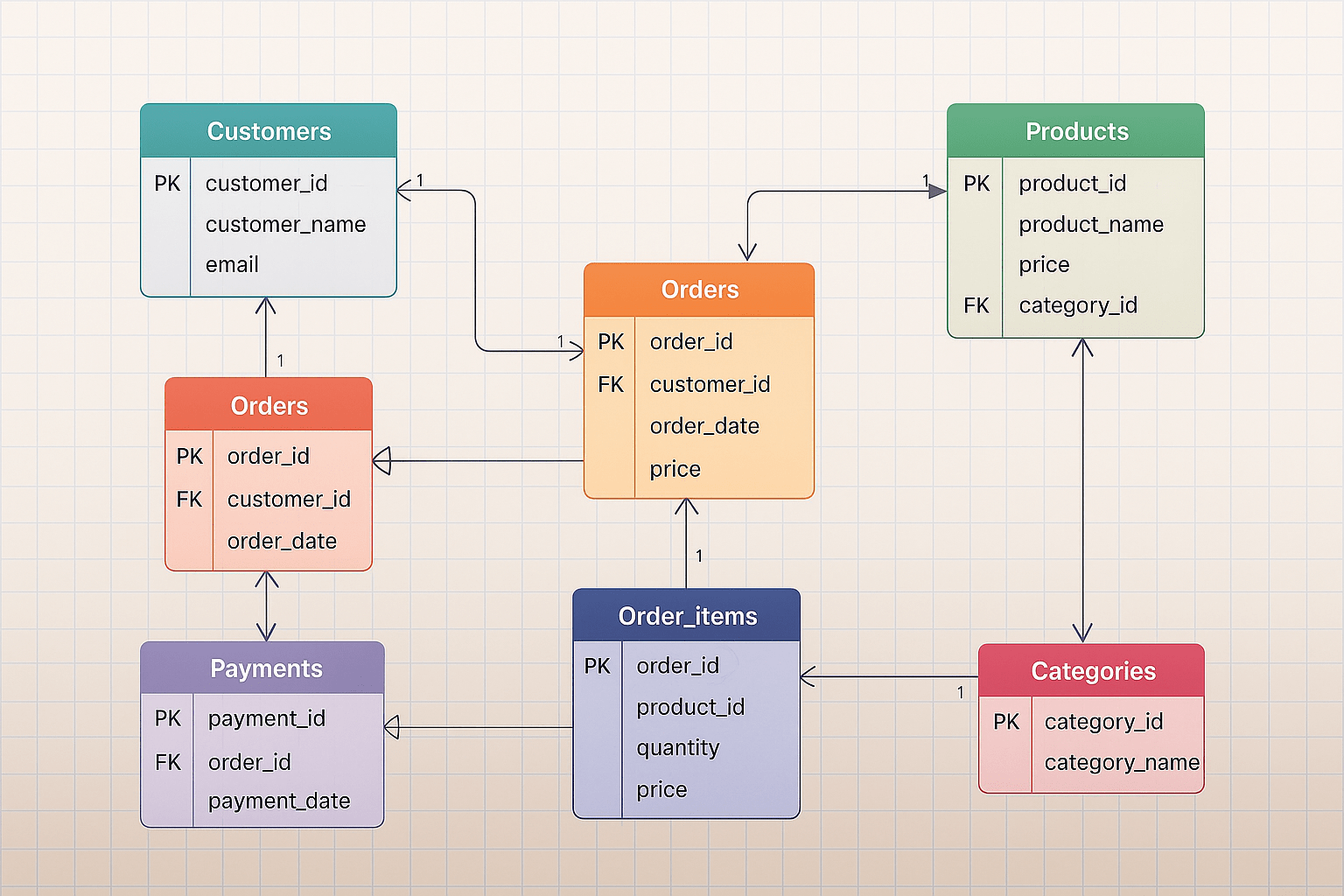
Sample ERD Structure (Online Store)
Customers (customer_id PK) |1 |∞ Orders (order_id PK, customer_id FK) |1 |∞ Order_Items (order_id FK, product_id FK) |∞ |1 Products (product_id PK)
2. Normal Forms (1NF → 3NF)
Normalization reduces redundancy and improves data integrity.
1NF – First Normal Form
Requirements:
-
No repeating groups
-
No multivalue fields
-
Each cell contains one value
Bad Example (not 1NF):
| order_id | product_ids |
|---|---|
| 101 | 5, 8, 9 |
✔ Fix: Move products to a separate table.
2NF – Second Normal Form
Requirements:
-
Already in 1NF
-
No partial dependency on a composite PK
Bad Example (order_items):
(order_id, product_id) → quantity product_name → depends only on product_id (partial dependency)
✔ Fix:
-
Keep product_name in products table only.
3NF – Third Normal Form
Requirements:
-
Already in 2NF
-
No transitive dependencies
Bad Example (employees):
employee_id → department_id → department_name
department_name depends on department_id, not employee_id.
✔ Fix:
Move department_name into a departments table.
3. Denormalization: When & Why
Normalization improves consistency, but sometimes hurts performance.
Reasons to Denormalize
-
Reduce JOINs in high-traffic systems
-
Improve read performance (e.g., analytics dashboards)
-
Cache aggregated values (e.g., total_order_value stored in orders)
Examples of Denormalization
-
Storing
customer_namedirectly inordersfor faster reporting -
Keeping
inventory_countin the product table instead of recalculating
Rule of thumb:
✔ Normalize by default
✔ Denormalize intentionally for performance or simplicity
4. Many-to-Many Relationships (Junction Tables)
A junction (bridge) table breaks M:N into two 1:N relationships.
Example: products ↔ categories
Products (product_id PK) Categories (category_id PK) Product_Categories ( product_id FK, category_id FK, PRIMARY KEY (product_id, category_id) )
This avoids duplication and allows products to belong to many categories.
5. Real-World Schema Design Examples
A. Online Store
-
customers
-
products
-
orders
-
order_items (junction table)
-
payments
-
inventory
-
categories + product_categories (junction table)
B. HR System
-
employees
-
departments
-
salaries
-
positions
-
employee_project_assignments (junction table)
C. Education / LMS
-
students
-
courses
-
enrollment (junction table)
-
instructors
-
assignments
-
submissions
These schemas rely on normalization, foreign keys, and relationship design.
6. Practical Exercises
Exercise 1: Design a database for an online store
Instructions:
-
Identify entities
-
Define attributes
-
Determine relationships
-
Build an ER diagram
Expected entities:
-
customers
-
products
-
orders
-
order_items
-
payments
-
categories
-
product_categories
I can generate a full ERD if you'd like.
Exercise 2: Normalize a messy spreadsheet
Given Messy Table
| OrderID | Customer | CustomerEmail | Products | Qty | PriceList |
|---|---|---|---|---|---|
| 101 | Alice | a@x.com | Keyboard,Mouse | 2,1 | 30,15 |
Problems:
-
Multiple values per cell
-
Mixed customer & order data
-
Repeating product information
Normalized Version
customers
(customer_id PK, name, email)
orders
(order_id PK, customer_id FK)
products
(product_id PK, product_name, price)
order_items
(order_id FK, product_id FK, quantity)
A complete ERD diagram for the store database


Comments (0)
No comments yet. Be the first to comment!