
Backend & APIs Topic
Architectural Design Patterns and Programming (or Software) Design Patterns
Understanding Architectural Design Patterns and Programming (or Software) Design Patterns is fundamental to building robust, scalable, and maintainable software systems. Let’s break them down clearly and compare them.
1. Architectural Design Patterns
Definition:
Architectural design patterns are high-level, system-wide patterns that define the overall structure and organization of a software system.
They focus on how components interact, how data flows, and how responsibilities are divided across the system.
They address global concerns, such as scalability, performance, and deployment.
Common Architectural Design Patterns
| Pattern | Description | Common Use Case |
|---|---|---|
| Layered (n-tier) | Organizes the system into layers (e.g., presentation, business, data). Each layer communicates only with the one below it. | Web applications, enterprise software (e.g., MVC apps). |
| Client–Server | Divides system into a client that requests services and a server that provides them. | Web services, distributed systems. |
| Microservices | Breaks a system into small, independent services that communicate via APIs. | Cloud-native applications, scalable systems. |
| Event-Driven | Components communicate via events; promotes loose coupling and asynchronous processing. | Real-time systems, IoT, financial trading platforms. |
| Pipe and Filter | Data flows through a series of processing components (filters) connected by pipes. | Data transformation, compiler design. |
| Service-Oriented Architecture (SOA) | Services communicate over a network via standardized interfaces. | Enterprise integrations, legacy system interoperability. |
| Model–View–Controller (MVC) | Separates data (Model), UI (View), and logic (Controller). | Web frameworks (e.g., Django, Spring MVC, ASP.NET MVC). |
| Hexagonal (Ports and Adapters) | Core logic is isolated from external systems via adapters and ports. | Systems needing high testability and adaptability. |
| Broker | Mediates communication between distributed components using a message broker. | Middleware, distributed systems. |
| Peer-to-Peer (P2P) | Every node can act as both a client and a server. | Torrent systems, blockchain, file sharing. |
2. Programming (Software) Design Patterns
Definition:
Programming (or software) design patterns are mid- to low-level solutions to common problems in software design and coding.
They don’t define the architecture, but rather how classes, objects, and methods interact within that architecture.
They are typically categorized based on their intent: Creational, Structural, and Behavioral.
Types of Programming Design Patterns
🏗 Creational Patterns
Deal with object creation mechanisms, trying to make the system independent of how objects are created.
| Pattern | Purpose | Example |
|---|---|---|
| Singleton | Ensures only one instance of a class exists. | Logger, configuration manager. |
| Factory Method | Creates objects without specifying the exact class. | UI components depending on platform. |
| Abstract Factory | Creates families of related objects. | Cross-platform GUI creation. |
| Builder | Constructs complex objects step-by-step. | Creating complex documents, houses, etc. |
| Prototype | Clones existing objects. | Game objects, object caching. |
Structural Patterns
Deal with object composition — how classes and objects can be combined to form larger structures.
| Pattern | Purpose | Example |
|---|---|---|
| Adapter | Makes incompatible interfaces work together. | Integrating legacy systems. |
| Bridge | Decouples abstraction from implementation. | GUI abstraction across platforms. |
| Composite | Treats individual objects and groups uniformly. | File system hierarchy. |
| Decorator | Dynamically adds behavior to an object. | UI theming, stream filtering. |
| Facade | Provides a simplified interface to a complex system. | Simplified API wrappers. |
| Flyweight | Reduces memory use by sharing common data. | Text rendering, game entities. |
| Proxy | Provides a placeholder for another object to control access. | Remote proxy, lazy initialization. |
Behavioral Patterns
Focus on communication and responsibility among objects.
| Pattern | Purpose | Example |
|---|---|---|
| Observer | Defines dependency so that objects get notified of changes. | Event listeners, UI updates. |
| Strategy | Defines a family of algorithms and makes them interchangeable. | Payment methods, sorting algorithms. |
| Command | Encapsulates a request as an object. | Undo/redo, GUI button actions. |
| Chain of Responsibility | Passes a request along a chain until handled. | Logging, event handling. |
| Mediator | Centralizes complex communication between objects. | Chatroom mediator, UI controls. |
| Memento | Saves and restores an object’s state. | Undo/rollback systems. |
| State | Changes behavior based on internal state. | Traffic lights, finite state machines. |
| Template Method | Defines the skeleton of an algorithm. | Framework hooks. |
| Visitor | Adds new operations to existing object structures. | Compilers, AST processing. |
| Interpreter | Defines a grammar and interpreter for a language. | Expression evaluators, rule engines. |
Key Difference Overview
| Aspect | Architectural Patterns | Programming Design Patterns |
|---|---|---|
| Scope | System-wide structure | Component or class level |
| Focus | High-level organization and interaction | Object creation, structure, behavior |
| Granularity | Coarse-grained | Fine-grained |
| Example | MVC, Microservices, Layered | Singleton, Factory, Observer |
| Goal | Define how components fit together | Solve recurring coding problems |
Software Design Hierarchy Overview
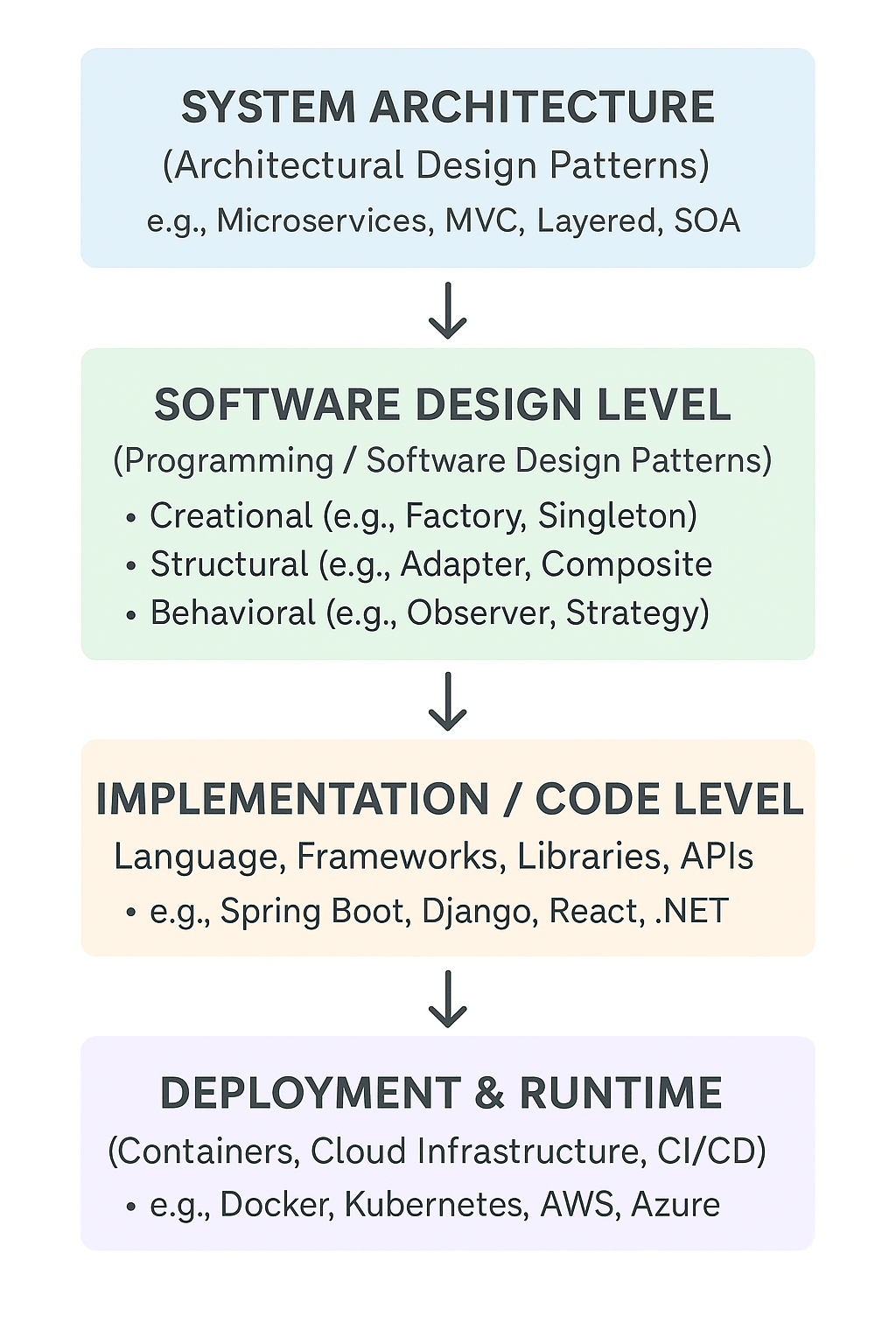
Comparison Table: Architectural vs Programming Design Patterns
| Level | Focus | Typical Patterns | Scope | Example Technologies |
|---|---|---|---|---|
| Architectural Design Patterns | Define the overall structure of the system and how components interact. | MVC, Microservices, Layered, Event-Driven, SOA, Hexagonal | Entire application | Spring Boot, Express.js, Django, .NET Core |
| Programming (Software) Design Patterns | Define class/object interactions and responsibilities. | Singleton, Factory, Adapter, Observer, Strategy | Component or module level | Java, Python, C#, JavaScript |
| Implementation Level | Realization of patterns in code. | Code libraries, APIs, frameworks. | Code and tools | React, Flask, Node.js, ASP.NET |
| Deployment Level | How software is packaged, deployed, and scaled. | Deployment topologies, CI/CD, Infrastructure as Code. | System operations | Docker, Kubernetes, AWS, Azure |
Example of Integration
Let’s take an example to see how these patterns combine in real life:
| Layer | Example in Action |
|---|---|
| Architectural Pattern | The system uses Microservices Architecture — each service handles a distinct business function. |
| Programming Design Pattern | Inside a microservice, developers use the Factory pattern to create different product objects, and Observer to notify other components when an event occurs. |
| Implementation Level | Built using Spring Boot (Java) or Express.js (Node.js). |
| Deployment | Deployed in Docker containers, orchestrated by Kubernetes, with CI/CD via GitHub Actions. |


Comments (0)
No comments yet. Be the first to comment!