
Backend & APIs Topic
Real-Time Stock Trading Platform System Design
1. Problem Statement
Design a real-time stock trading platform supporting:
-
Real-time market data streaming (ticks, LTP, depth)
-
Order placement (limit, market, stop-loss)
-
Portfolio tracking with P&L
-
Charting with technical indicators
-
News and sentiment analysis
-
Alerts and notifications
-
Risk management and compliance
-
High-frequency trading support
-
Support for 10M+ active users, 1M+ concurrent connections
2. System Requirements
Functional Requirements:
-
Market Data:
-
Real-time tick-by-tick data (NSE, BSE, MCX)
-
Level 2 market depth (order book)
-
Index values and sector performance
-
Historical data (1 min to 1 year)
-
-
Trading Features:
-
Buy/sell orders (intraday, delivery, margin)
-
Order types: Market, Limit, Stop-loss, Bracket, Cover
-
Order modification and cancellation
-
Basket orders
-
SIP (Systematic Investment Plan)
-
-
Portfolio Management:
-
Real-time P&L calculation
-
Position tracking
-
Margin utilization
-
Tax P&L statements
-
Dividend tracking
-
-
Analytics & Research:
-
Advanced charting (candlestick, line, Heikin-Ashi)
-
Technical indicators (200+ indicators)
-
Backtesting engine
-
Screeners and scanners
-
News and corporate announcements
-
-
Risk Management:
-
Pre-trade risk checks
-
Position limits
-
Margin requirements
-
Circuit breaker enforcement
-
Compliance monitoring
-
Non-Functional Requirements:
-
Latency: < 10ms for order execution
-
Throughput: 100,000+ orders/second
-
Availability: 99.99% uptime (zero downtime during market hours)
-
Data Consistency: Strong consistency for orders, eventual for market data
-
Scalability: Handle 1M+ concurrent WebSocket connections
-
Security: Bank-grade security, 2FA, encryption at rest and transit
-
Regulatory Compliance: SEBI, GDPR, KYC norms
-
Fault Tolerance: Zero data loss, automatic failover
3. High-Level Architecture
text
┌─────────────────────────────────────────────────────────────────────┐
│                         Client Applications                          │
├────────────────────┬────────────────────┬───────────────────────────┤
│   Kite Web         │   Kite Mobile      │   Console/API             │
│   (React)          │   (Flutter/React)  │   (REST/WebSocket)        │
└────────────────────┴────────────────────┴───────────────────────────┘
                                  │
┌─────────────────────────────────▼───────────────────────────────────┐
│                  Global Load Balancer (Anycast)                      │
│                 (WAF, DDoS Protection, SSL Termination)              │
└────────────────────┬─────────────────────────────────────────────────┘
                     │
┌────────────────────▼─────────────────────────────────────────────────┐
│                      API Gateway Cluster                             │
│               (Rate Limiting, Authentication, Routing)               │
└────────────────────┬─────────────────────────────────────────────────┘
                     │
┌────────────────────▼─────────────────────────────────────────────────┐
│                  Microservices Ecosystem                             │
├──────────┬──────────┬──────────┬──────────┬──────────┬──────────────┤
│Order Mgmt│Market Data│ Portfolio │   Risk   │  User    │  Analytics  │
│ Service  │ Service   │ Service   │ Service  │ Service  │  Service    │
├──────────┴──────────┴──────────┴──────────┴──────────┴──────────────┤
│                    Service Mesh (Istio/Linkerd)                      │
└─────────────────────────────┬────────────────────────────────────────┘
                              │
┌─────────────────────────────▼────────────────────────────────────────┐
│                    Message Bus (Kafka/Pulsar)                        │
│        (Event Sourcing, CQRS, Real-time Event Streaming)             │
└─────────────┬──────────────────┬─────────────────────────────────────┘
              │                  │
    ┌─────────▼──────┐  ┌────────▼────────┐  ┌──────────────────────┐
    │ Exchange       │  │ Market Data     │  │ External             │
    │ Gateway        │  │ Feed Handlers   │  │ APIs                 │
    │ (OMD/ITCH)     │  │ (TCP/UDP)       │  │ (News, Fundamentals) │
    └────────┬───────┘  └────────┬────────┘  └──────────────────────┘
             │                   │
    ┌────────▼───────────────────▼────────┐
    │           Data Storage Layer        │
    ├──────────┬──────────┬───────────────┤
    │   Times-  │  Orders  │   Cache       │
    │   series  │   DB     │   (Redis)     │
    │ (DolphinDB│ (PostgreSQL│   (Hazelcast)│
    │ /QuestDB) │ /Cockroach)│              │
    └──────────┴──────────┴───────────────┘
4. Component Design Deep Dive
4.1 Market Data Feed Architecture
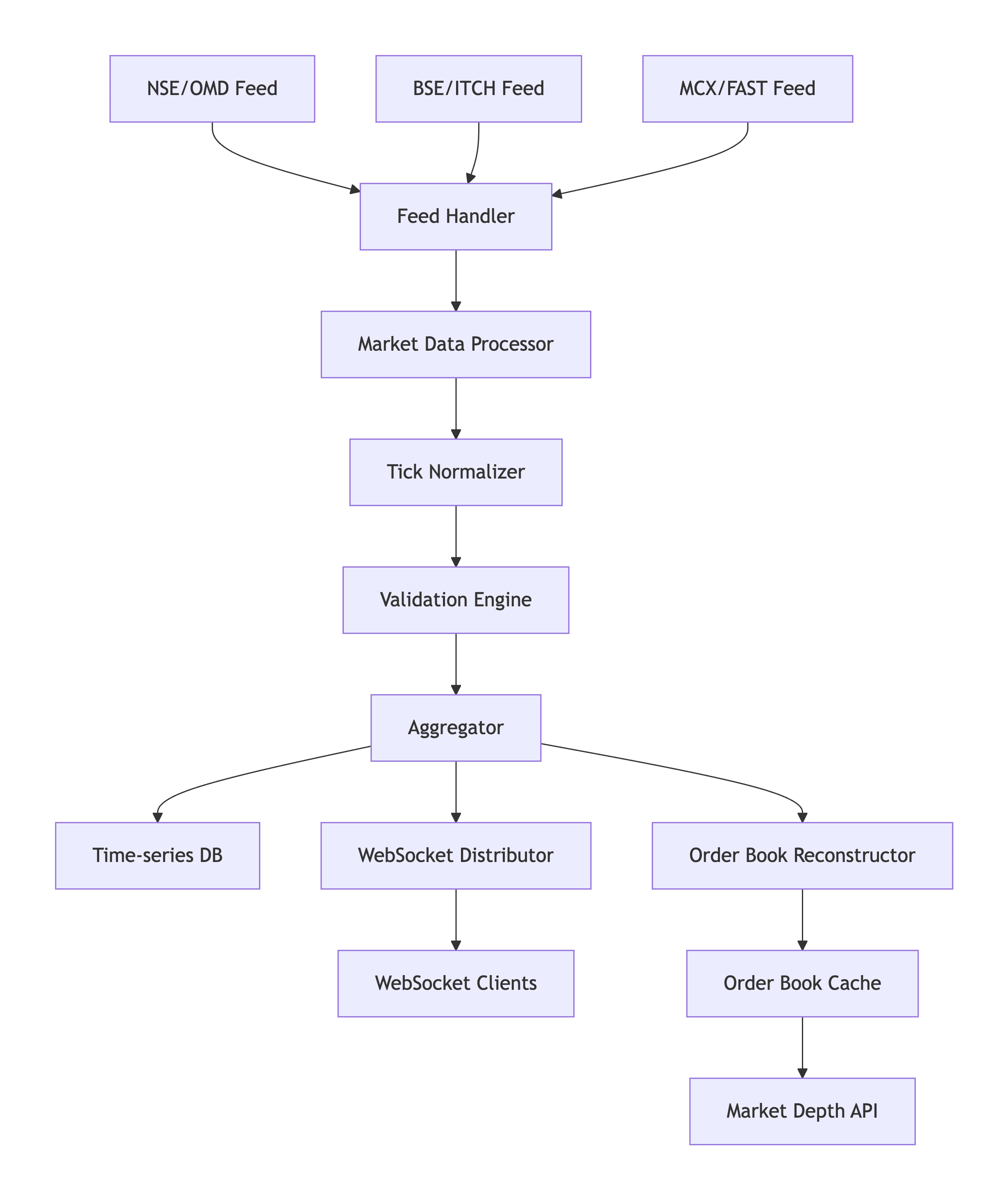
Feed Handler Implementation:
cpp
// High-performance C++ feed handler for low latency
class OMDFeedHandler {
private:
    tcp::socket socket_;
    char buffer_[65536];
    std::atomic<uint64_t> sequence_number_;
    MarketDataProcessor& processor_;

public:
    void start() {
        asio::async_read(socket_, asio::buffer(buffer_, sizeof(OMDHeader)),
            [this](const asio::error_code& ec, size_t bytes) {
                if (!ec) process_packet();
            });
    }

    void process_packet() {
        auto* header = reinterpret_cast<OMDHeader*>(buffer_);

        // Validate sequence number
        if (header->sequence != sequence_number_.load() + 1) {
            handle_sequence_gap();
            return;
        }
        sequence_number_.store(header->sequence);

        // Process based on packet type
        switch (header->packet_type) {
            case PacketType::LOGIN_RESPONSE:
                handle_login_response();
                break;
            case PacketType::MARKET_DATA:
                process_market_data();
                break;
            case PacketType::HEARTBEAT:
                send_heartbeat_ack();
                break;
        }

        // Continue reading
        start();
    }

    void process_market_data() {
        auto* market_data = reinterpret_cast<MarketDataPacket*>(buffer_);

        // Convert to internal format with nanosecond timestamp
        Tick tick{
            .instrument_id = market_data->instrument_token,
            .timestamp = get_nanoseconds(),
            .last_price = market_data->last_traded_price,
            .volume = market_data->volume_traded,
            .bid_price = market_data->best_bid_price,
            .bid_quantity = market_data->best_bid_quantity,
            .ask_price = market_data->best_ask_price,
            .ask_quantity = market_data->best_ask_quantity,
            .open_interest = market_data->open_interest
        };

        // Send to processor (lock-free queue)
        processor_.push_tick(tick);
    }
};
4.2 Real-time Data Distribution System
java
// WebSocket distribution with Aeron (low-latency messaging)
public class MarketDataDistributor {
    private final Aeron aeron;
    private final Publication publication;
    private final Map<String, Subscription> subscriptions;
    private final RingBuffer<Tick> tickBuffer;

    public MarketDataDistributor() {
        // Initialize Aeron for ultra-low latency IPC
        aeron = Aeron.connect(new Context()
            .aeronDirectoryName("/dev/shm/aeron")
            .threadingMode(ThreadingMode.DEDICATED));

        // Create publication for broadcasting ticks
        publication = aeron.addPublication(
            "aeron:ipc",
            MARKET_DATA_STREAM_ID);

        // Lock-free ring buffer for tick processing
        tickBuffer = new RingBuffer<>(TICK_BUFFER_SIZE);
    }

    public void distributeTick(Tick tick) {
        // Serialize tick to binary format
        ByteBuffer buffer = ByteBuffer.allocate(TICK_SIZE);
        buffer.putLong(tick.timestamp);
        buffer.putInt(tick.instrumentId);
        buffer.putLong(tick.lastPrice);
        buffer.putInt(tick.volume);
        buffer.putLong(tick.bidPrice);
        buffer.putInt(tick.bidQuantity);
        buffer.putLong(tick.askPrice);
        buffer.putInt(tick.askQuantity);

        // Publish via Aeron (nanosecond latency)
        long result = publication.offer(buffer);

        if (result < 0) {
            // Buffer backpressure - log and handle
            handleBackpressure(tick);
        }

        // Also update WebSocket connections
        updateWebSocketClients(tick);
    }

    private void updateWebSocketClients(Tick tick) {
        // Get all subscribers for this instrument
        Set<WebSocketSession> subscribers =
            subscriptionManager.getSubscribers(tick.instrumentId);

        // Prepare message (binary or JSON based on client capability)
        byte[] message = prepareMessage(tick);

        // Send to each subscriber (non-blocking)
        for (WebSocketSession session : subscribers) {
            if (session.isOpen()) {
                session.getAsyncRemote().sendBinary(
                    ByteBuffer.wrap(message));
            }
        }
    }

    // Binary protocol for efficiency
    private byte[] prepareMessage(Tick tick) {
        ByteBuffer buffer = ByteBuffer.allocate(64);
        buffer.put((byte) 0x01); // Message type: TICK
        buffer.putInt(tick.instrumentId);
        buffer.putLong(tick.lastPrice);
        buffer.putInt(tick.volume);
        buffer.putLong(tick.timestamp);
        return buffer.array();
    }
}
4.3 Order Management System (OMS)
python
# Order Service with event sourcing
class OrderService:
    def __init__(self):
        self.order_store = OrderStore()
        self.risk_engine = RiskEngine()
        self.exchange_gateway = ExchangeGateway()
        self.event_bus = EventBus()

    async def place_order(self, order_request: OrderRequest) -> OrderResponse:
        # 1. Generate order ID
        order_id = self.generate_order_id()

        # 2. Create order event
        order_created = OrderCreatedEvent(
            order_id=order_id,
            user_id=order_request.user_id,
            instrument_token=order_request.instrument_token,
            transaction_type=order_request.transaction_type,
            quantity=order_request.quantity,
            price=order_request.price,
            order_type=order_request.order_type,
            product_type=order_request.product_type,
            timestamp=datetime.utcnow()
        )

        # 3. Validate and apply risk checks
        risk_result = await self.risk_engine.validate_order(order_created)
        if not risk_result.approved:
            return OrderResponse(
                order_id=order_id,
                status=OrderStatus.REJECTED,
                rejection_reason=risk_result.reason
            )

        # 4. Persist event
        await self.order_store.append_event(order_created)

        # 5. Route to exchange
        if order_request.order_type == OrderType.MARKET:
            exchange_response = await self.exchange_gateway.send_market_order(
                order_created
            )
        else:
            exchange_response = await self.exchange_gateway.send_limit_order(
                order_created
            )

        # 6. Update order status
        if exchange_response.accepted:
            order_placed = OrderPlacedEvent(
                order_id=order_id,
                exchange_order_id=exchange_response.exchange_order_id,
                timestamp=datetime.utcnow()
            )
            await self.order_store.append_event(order_placed)

            # Publish event
            await self.event_bus.publish(order_placed)

            return OrderResponse(
                order_id=order_id,
                status=OrderStatus.PENDING,
                exchange_order_id=exchange_response.exchange_order_id
            )
        else:
            order_rejected = OrderRejectedEvent(
                order_id=order_id,
                reason=exchange_response.rejection_reason,
                timestamp=datetime.utcnow()
            )
            await self.order_store.append_event(order_rejected)

            return OrderResponse(
                order_id=order_id,
                status=OrderStatus.REJECTED,
                rejection_reason=exchange_response.rejection_reason
            )

    async def get_order_state(self, order_id: str) -> OrderState:
        # Reconstruct order state from event stream
        events = await self.order_store.get_events(order_id)

        order_state = OrderState()
        for event in events:
            if isinstance(event, OrderCreatedEvent):
                order_state.apply_created(event)
            elif isinstance(event, OrderPlacedEvent):
                order_state.apply_placed(event)
            elif isinstance(event, OrderPartiallyFilledEvent):
                order_state.apply_partial_fill(event)
            elif isinstance(event, OrderFilledEvent):
                order_state.apply_fill(event)
            elif isinstance(event, OrderCancelledEvent):
                order_state.apply_cancelled(event)
            elif isinstance(event, OrderRejectedEvent):
                order_state.apply_rejected(event)

        return order_state

    async def cancel_order(self, order_id: str) -> bool:
        # Get current order state
        order_state = await self.get_order_state(order_id)

        if order_state.status not in [OrderStatus.PENDING, OrderStatus.PARTIALLY_FILLED]:
            return False

        # Send cancellation to exchange
        cancellation_response = await self.exchange_gateway.cancel_order(
            order_state.exchange_order_id
        )

        if cancellation_response.success:
            # Record cancellation event
            cancelled_event = OrderCancelledEvent(
                order_id=order_id,
                cancelled_by='USER',
                timestamp=datetime.utcnow()
            )
            await self.order_store.append_event(cancelled_event)
            await self.event_bus.publish(cancelled_event)

            return True

        return False
4.4 Risk Management Engine
java
// Real-time risk checking with complex rules
@Component
public class RiskEngine {

    @Autowired
    private PositionRepository positionRepository;

    @Autowired
    private MarginCalculator marginCalculator;

    @Autowired
    private CircuitBreakerService circuitBreakerService;

    @Autowired
    private RateLimiter rateLimiter;

    public RiskCheckResult validateOrder(Order order) {
        List<RiskRule> rules = Arrays.asList(
            new PositionLimitRule(),
            new MarginRequirementRule(),
            new CircuitBreakerRule(),
            new OrderRateLimitRule(),
            new BlackoutPeriodRule(),
            new InstrumentSpecificRule(),
            new ClientCategoryRule()
        );

        RiskContext context = new RiskContext(order);

        // Load current positions
        List<Position> positions = positionRepository
            .findByUserId(order.getUserId());
        context.setPositions(positions);

        // Calculate margins
        MarginRequirements margins = marginCalculator
            .calculate(order, positions);
        context.setMargins(margins);

        // Execute rules in parallel
        List<CompletableFuture<RiskRuleResult>> futures = rules.stream()
            .map(rule -> CompletableFuture.supplyAsync(() ->
                rule.evaluate(context)))
            .collect(Collectors.toList());

        // Wait for all rules to complete
        CompletableFuture.allOf(futures.toArray(new CompletableFuture[0]))
            .join();

        // Combine results
        List<RiskRuleResult> results = futures.stream()
            .map(CompletableFuture::join)
            .collect(Collectors.toList());

        // Check for any violations
        Optional<RiskRuleResult> violation = results.stream()
            .filter(result -> !result.isPassed())
            .findFirst();

        if (violation.isPresent()) {
            return RiskCheckResult.rejected(
                violation.get().getReason(),
                violation.get().getCode()
            );
        }

        return RiskCheckResult.approved();
    }

    // Real-time margin calculation
    public MarginRequirements calculate(Order order, List<Position> positions) {
        MarginRequirements requirements = new MarginRequirements();

        // SPAN margin calculation
        SpanMargin spanMargin = calculateSpanMargin(order, positions);
        requirements.setSpanMargin(spanMargin);

        // Exposure margin
        ExposureMargin exposureMargin = calculateExposureMargin(order, positions);
        requirements.setExposureMargin(exposureMargin);

        // VAR margin
        VarMargin varMargin = calculateVarMargin(order, positions);
        requirements.setVarMargin(varMargin);

        // Extreme loss margin
        ExtremeLossMargin elm = calculateExtremeLossMargin(order, positions);
        requirements.setExtremeLossMargin(elm);

        // Total margin requirement
        BigDecimal totalMargin = spanMargin.getValue()
            .add(exposureMargin.getValue())
            .add(varMargin.getValue())
            .add(elm.getValue());

        requirements.setTotalMargin(totalMargin);

        // Check against available margin
        BigDecimal availableMargin = getAvailableMargin(order.getUserId());
        requirements.setAvailableMargin(availableMargin);
        requirements.setSufficient(availableMargin.compareTo(totalMargin) >= 0);

        return requirements;
    }

    // Circuit breaker check
    private boolean checkCircuitBreaker(String instrumentId, BigDecimal price) {
        CircuitBreakerStatus status = circuitBreakerService
            .getStatus(instrumentId);

        if (status.isTriggered()) {
            PriceBand band = status.getPriceBand();
            return price.compareTo(band.getLowerLimit()) >= 0
                && price.compareTo(band.getUpperLimit()) <= 0;
        }

        return true;
    }
}
5. Data Storage Architecture
5.1 Time-series Data Storage
sql
-- DolphinDB/QuestDB schema for high-frequency data
-- Create time-series partitioned tables

-- Ticks table (nanosecond precision)
CREATE TABLE ticks (
    symbol SYMBOL CAPACITY 1000,
    exchange SYMBOL CAPACITY 10,
    timestamp TIMESTAMP,
    price DOUBLE,
    volume LONG,
    bid_price DOUBLE,
    bid_quantity LONG,
    ask_price DOUBLE,
    ask_quantity LONG,
    trade_type SYMBOL CAPACITY 10,
    trade_id LONG
) PARTITION BY DAY
  WITH maxUncommittedRows=250000,
       o3MaxLag=100ms;

-- OHLCV aggregated data
CREATE TABLE ohlcv_1min (
    symbol SYMBOL,
    timestamp TIMESTAMP,
    open DOUBLE,
    high DOUBLE,
    low DOUBLE,
    close DOUBLE,
    volume LONG,
    vwap DOUBLE
) PARTITION BY MONTH
  INDEX (symbol);

-- Order book snapshots
CREATE TABLE order_book_snapshots (
    symbol SYMBOL,
    timestamp TIMESTAMP,
    bids ARRAY(DOUBLE, LONG),  -- Array of [price, quantity]
    asks ARRAY(DOUBLE, LONG),
    total_bid_quantity LONG,
    total_ask_quantity LONG
) PARTITION BY DAY;

-- Create materialized views for common queries
CREATE MATERIALIZED VIEW daily_summary AS
SELECT
    symbol,
    date_trunc('day', timestamp) as date,
    first(price) as open,
    max(price) as high,
    min(price) as low,
    last(price) as close,
    sum(volume) as volume,
    sum(price * volume) / sum(volume) as vwap
FROM ticks
SAMPLE BY 1d
ALIGN TO CALENDAR;

-- Time-bucket queries
SELECT
    bucket,
    symbol,
    first(price) as open,
    max(price) as high,
    min(price) as low,
    last(price) as close,
    sum(volume) as volume
FROM ticks
WHERE symbol = 'RELIANCE'
  AND timestamp >= '2024-01-15'
SAMPLE BY 5m
ALIGN TO CALENDAR;
5.2 Orders & Portfolio Database
sql
-- CockroachDB schema for distributed ACID transactions
-- Orders table with partitioning
CREATE TABLE orders (
    order_id UUID DEFAULT gen_random_uuid() PRIMARY KEY,
    user_id UUID NOT NULL,
    exchange_order_id STRING,
    instrument_token INT NOT NULL,
    transaction_type STRING NOT NULL, -- BUY/SELL
    quantity INT NOT NULL,
    disclosed_quantity INT,
    price DECIMAL(18, 2),
    trigger_price DECIMAL(18, 2),
    order_type STRING NOT NULL, -- MARKET/LIMIT/SL/SL-M
    product_type STRING NOT NULL, -- CNC/MIS/NRML
    validity STRING DEFAULT 'DAY', -- DAY/IOC
    status STRING NOT NULL, -- PENDING/COMPLETE/CANCELLED/REJECTED
    status_message STRING,
    filled_quantity INT DEFAULT 0,
    pending_quantity INT,
    average_price DECIMAL(18, 2),
    exchange_timestamp TIMESTAMPTZ,
    created_at TIMESTAMPTZ DEFAULT now(),
    updated_at TIMESTAMPTZ DEFAULT now(),
    INDEX idx_user_created (user_id, created_at DESC),
    INDEX idx_status (status, created_at),
    FAMILY order_details (instrument_token, transaction_type, quantity, price),
    FAMILY status_details (status, filled_quantity, average_price)
) PARTITION BY LIST (status) (
    PARTITION pending VALUES IN ('PENDING', 'OPEN'),
    PARTITION completed VALUES IN ('COMPLETE', 'REJECTED', 'CANCELLED')
);

-- Order executions/trades
CREATE TABLE trades (
    trade_id UUID DEFAULT gen_random_uuid() PRIMARY KEY,
    order_id UUID REFERENCES orders(order_id),
    exchange_trade_id STRING NOT NULL,
    instrument_token INT NOT NULL,
    quantity INT NOT NULL,
    price DECIMAL(18, 2) NOT NULL,
    trade_type STRING NOT NULL, -- BUY/SELL
    trade_timestamp TIMESTAMPTZ NOT NULL,
    created_at TIMESTAMPTZ DEFAULT now(),
    INDEX idx_order_trades (order_id, trade_timestamp),
    INDEX idx_instrument_time (instrument_token, trade_timestamp)
);

-- Portfolio positions
CREATE TABLE positions (
    position_id UUID DEFAULT gen_random_uuid() PRIMARY KEY,
    user_id UUID NOT NULL,
    instrument_token INT NOT NULL,
    product_type STRING NOT NULL, -- CNC/MIS
    quantity INT NOT NULL,
    average_price DECIMAL(18, 2) NOT NULL,
    last_price DECIMAL(18, 2),
    pnl DECIMAL(18, 2),
    unrealized_pnl DECIMAL(18, 2),
    realized_pnl DECIMAL(18, 2),
    day_pnl DECIMAL(18, 2),
    margin_used DECIMAL(18, 2),
    created_at TIMESTAMPTZ DEFAULT now(),
    updated_at TIMESTAMPTZ DEFAULT now(),
    UNIQUE (user_id, instrument_token, product_type),
    INDEX idx_user_positions (user_id, updated_at DESC)
);

-- Ledger for fund management
CREATE TABLE ledger (
    ledger_id UUID DEFAULT gen_random_uuid() PRIMARY KEY,
    user_id UUID NOT NULL,
    entry_type STRING NOT NULL, -- CREDIT/DEBIT
    amount DECIMAL(18, 2) NOT NULL,
    balance DECIMAL(18, 2) NOT NULL,
    description STRING NOT NULL,
    reference_id STRING, -- Order ID, Trade ID, etc.
    reference_type STRING, -- ORDER, TRADE, PAYMENT, DIVIDEND
    transaction_date DATE NOT NULL,
    created_at TIMESTAMPTZ DEFAULT now(),
    INDEX idx_user_ledger (user_id, transaction_date DESC),
    INDEX idx_user_balance (user_id, created_at DESC)
);
5.3 In-Memory Cache Architecture
python
# Multi-level caching strategy
class TradingCache:
    def __init__(self):
        # L1: Local cache (Guava/Caffeine)
        self.local_cache = CacheBuilder.newBuilder()
            .maximum_size(100000)
            .expireAfterWrite(1, TimeUnit.SECONDS)
            .recordStats()
            .build()

        # L2: Redis cluster
        self.redis_client = RedisCluster(
            startup_nodes=[
                {'host': 'redis-1', 'port': 6379},
                {'host': 'redis-2', 'port': 6379},
                {'host': 'redis-3', 'port': 6379}
            ],
            decode_responses=False
        )

        # L3: Hazelcast for distributed objects
        self.hazelcast = hazelcast.HazelcastClient()
        self.order_book_cache = self.hazelcast.get_map("order_books")
        self.positions_cache = self.hazelcast.get_map("positions")

    async def get_market_data(self, instrument_token: int) -> MarketData:
        # Try L1 cache
        cache_key = f"market_data:{instrument_token}"
        data = self.local_cache.getIfPresent(cache_key)

        if data:
            return data

        # Try L2 cache
        data = await self.redis_client.get(cache_key)
        if data:
            # Deserialize and store in L1
            market_data = self.deserialize_market_data(data)
            self.local_cache.put(cache_key, market_data)
            return market_data

        # Fetch from database
        market_data = await self.fetch_from_database(instrument_token)

        # Update caches asynchronously
        asyncio.create_task(self.update_caches(cache_key, market_data))

        return market_data

    async def get_order_book(self, instrument_token: int) -> OrderBook:
        # Check distributed cache first
        order_book = await self.order_book_cache.get(instrument_token)

        if order_book and not self.is_stale(order_book.timestamp):
            return order_book

        # Reconstruct from market data feed
        order_book = await self.reconstruct_order_book(instrument_token)

        # Update cache asynchronously
        asyncio.create_task(
            self.order_book_cache.set_async(instrument_token, order_book)
        )

        return order_book

    async def get_portfolio(self, user_id: str) -> Portfolio:
        cache_key = f"portfolio:{user_id}"

        # Check if portfolio needs recalculation
        last_update = await self.redis_client.get(f"{cache_key}:updated_at")
        if last_update and time.time() - float(last_update) < 5:
            # Return cached portfolio
            portfolio_data = await self.redis_client.get(cache_key)
            return self.deserialize_portfolio(portfolio_data)

        # Recalculate portfolio
        portfolio = await self.calculate_portfolio(user_id)

        # Cache with 5-second TTL
        pipeline = self.redis_client.pipeline()
        pipeline.set(cache_key, self.serialize_portfolio(portfolio))
        pipeline.set(f"{cache_key}:updated_at", time.time())
        pipeline.expire(cache_key, 10)
        pipeline.expire(f"{cache_key}:updated_at", 10)
        await pipeline.execute()

        return portfolio
6. Real-time P&L Calculation
java
// Incremental P&L calculation with Spark Streaming
public class PnLCalculator {

    public Dataset<Row> calculateRealTimePnL(
        Dataset<Tick> marketData,
        Dataset<Position> positions) {

        // Join positions with latest market data
        Dataset<Row> joined = positions.join(
            marketData,
            positions.col("instrument_token")
                .equalTo(marketData.col("instrument_token")),
            "left_outer"
        );

        // Calculate P&L for each position
        Dataset<Row> pnl = joined.select(
            positions.col("user_id"),
            positions.col("instrument_token"),
            positions.col("quantity"),
            positions.col("average_price"),
            marketData.col("last_price").as("current_price"),
            expressions.lit(System.currentTimeMillis()).as("timestamp"),
            // Unrealized P&L
            when(positions.col("transaction_type").equalTo("BUY"),
                (marketData.col("last_price")
                    .minus(positions.col("average_price")))
                    .multiply(positions.col("quantity"))
            ).otherwise(
                (positions.col("average_price")
                    .minus(marketData.col("last_price")))
                    .multiply(positions.col("quantity"))
            ).as("unrealized_pnl"),
            // Day P&L (from start of day)
            calculateDayPnl(positions, marketData).as("day_pnl")
        );

        // Aggregate by user
        Dataset<Row> aggregated = pnl.groupBy("user_id")
            .agg(
                sum("unrealized_pnl").as("total_unrealized_pnl"),
                sum("day_pnl").as("total_day_pnl"),
                countDistinct("instrument_token").as("positions_count")
            );

        return aggregated;
    }

    // Windowed calculation for charts
    public Dataset<Row> calculatePnLHistory(
        String userId,
        String timeframe) {

        // Get trade history
        Dataset<Trade> trades = spark.read()
            .table("trades")
            .filter(col("user_id").equalTo(userId))
            .as(Encoders.bean(Trade.class));

        // Calculate realized P&L per trade
        Dataset<Row> tradePnl = trades.select(
            col("instrument_token"),
            col("trade_timestamp"),
            col("quantity"),
            col("price"),
            col("trade_type"),
            // FIFO cost calculation
            calculateFifoCost(
                col("instrument_token"),
                col("trade_timestamp"),
                col("quantity"),
                col("trade_type")
            ).as("cost_price"),
            // Realized P&L
            when(col("trade_type").equalTo("BUY"),
                lit(0.0)
            ).otherwise(
                (col("price").minus(col("cost_price")))
                    .multiply(col("quantity"))
            ).as("realized_pnl")
        );

        // Group by time window
        Dataset<Row> windowedPnl = tradePnl
            .withWatermark("trade_timestamp", "1 hour")
            .groupBy(
                window(col("trade_timestamp"), timeframe),
                col("instrument_token")
            )
            .agg(
                sum("realized_pnl").as("period_pnl"),
                sum("quantity").as("volume")
            );

        return windowedPnl;
    }
}
7. Charting & Technical Analysis Engine
typescript
// WebAssembly-based charting engine for high-performance
class ChartEngine {
    private wasmModule: WebAssembly.Module;
    private chartBuffer: SharedArrayBuffer;

    async init() {
        // Load WebAssembly module for calculations
        this.wasmModule = await WebAssembly.compile(
            await fetch('/chart-engine.wasm')
        );

        // Shared buffer for efficient data transfer
        this.chartBuffer = new SharedArrayBuffer(1024 * 1024); // 1MB

        // Initialize worker pool
        this.workers = this.createWorkerPool(4);
    }

    async renderChart(
        instrumentToken: number,
        timeframe: string,
        indicators: Indicator[]
    ): Promise<ChartData> {
        // Get OHLC data
        const ohlcData = await this.fetchOHLC(instrumentToken, timeframe);

        // Calculate indicators in parallel
        const indicatorPromises = indicators.map(indicator =>
            this.calculateIndicator(ohlcData, indicator)
        );

        const indicatorResults = await Promise.all(indicatorPromises);

        // Prepare WebAssembly memory
        const wasmMemory = new WebAssembly.Memory({
            initial: 256,
            maximum: 512
        });

        // Copy data to WebAssembly memory
        const dataView = new DataView(wasmMemory.buffer);
        this.copyToWasmMemory(dataView, ohlcData);

        // Execute WebAssembly for heavy calculations
        const instance = await WebAssembly.instantiate(
            this.wasmModule,
            { env: { memory: wasmMemory } }
        );

        // Calculate support/resistance levels
        const srLevels = instance.exports.calculateSupportResistance(
            ohlcData.length,
            20 // Lookback period
        );

        // Calculate Fibonacci retracement
        const fibLevels = instance.exports.calculateFibonacci(
            ohlcData.high,
            ohlcData.low
        );

        // Generate candle patterns
        const patterns = instance.exports.detectCandlePatterns(
            ohlcData.open,
            ohlcData.high,
            ohlcData.low,
            ohlcData.close
        );

        return {
            ohlc: ohlcData,
            indicators: indicatorResults,
            supportResistance: srLevels,
            fibonacci: fibLevels,
            patterns: patterns,
            volumeProfile: await this.calculateVolumeProfile(ohlcData)
        };
    }

    private async calculateIndicator(
        data: OHLCData,
        indicator: Indicator
    ): Promise<IndicatorData> {
        switch (indicator.type) {
            case 'SMA':
                return this.calculateSMA(data.close, indicator.period);
            case 'EMA':
                return this.calculateEMA(data.close, indicator.period);
            case 'RSI':
                return this.calculateRSI(data.close, indicator.period);
            case 'MACD':
                return this.calculateMACD(data.close);
            case 'BollingerBands':
                return this.calculateBollingerBands(data.close, indicator.period);
            case 'VWAP':
                return this.calculateVWAP(data);
            case 'ATR':
                return this.calculateATR(data);
            default:
                throw new Error(`Unknown indicator: ${indicator.type}`);
        }
    }

    private calculateSMA(data: number[], period: number): number[] {
        const sma: number[] = [];
        for (let i = period - 1; i < data.length; i++) {
            const sum = data.slice(i - period + 1, i + 1)
                .reduce((a, b) => a + b, 0);
            sma.push(sum / period);
        }
        return sma;
    }

    // Volume Weighted Average Price
    private calculateVWAP(data: OHLCData): number[] {
        const vwap: number[] = [];
        let cumulativeTPV = 0;
        let cumulativeVolume = 0;

        for (let i = 0; i < data.close.length; i++) {
            const typicalPrice = (data.high[i] + data.low[i] + data.close[i]) / 3;
            cumulativeTPV += typicalPrice * data.volume[i];
            cumulativeVolume += data.volume[i];
            vwap.push(cumulativeTPV / cumulativeVolume);
        }

        return vwap;
    }
}
8. News & Sentiment Analysis
python
class SentimentAnalyzer:
    def __init__(self):
        self.nlp_pipeline = transformers.pipeline(
            "sentiment-analysis",
            model="ProsusAI/finbert",
            device=0 if torch.cuda.is_available() else -1
        )

        self.news_feed = NewsFeed()
        self.social_monitor = SocialMonitor()
        self.redis_client = redis.Redis()

    async def analyze_news_sentiment(self, symbol: str) -> SentimentScore:
        # Fetch recent news
        news_articles = await self.news_feed.get_articles(symbol, limit=50)

        # Analyze each article
        sentiment_scores = []
        for article in news_articles:
            # Extract text
            text = f"{article.title}. {article.summary}"

            # Get sentiment
            result = self.nlp_pipeline(text)[0]

            sentiment_scores.append({
                'article_id': article.id,
                'sentiment': result['label'],
                'score': result['score'],
                'timestamp': article.published_at
            })

        # Calculate weighted average
        weighted_score = self.calculate_weighted_sentiment(sentiment_scores)

        # Store in cache
        cache_key = f"sentiment:{symbol}:{datetime.utcnow().strftime('%Y%m%d')}"
        await self.redis_client.setex(
            cache_key,
            3600,  # 1 hour TTL
            json.dumps(weighted_score)
        )

        return weighted_score

    async def monitor_social_sentiment(self, symbol: str):
        # Monitor Twitter, Reddit, Telegram
        social_posts = await self.social_monitor.get_posts(symbol)

        # Real-time sentiment analysis
        for post in social_posts:
            sentiment = self.analyze_social_post(post)

            # Publish to Kafka for real-time dashboard
            await self.kafka_producer.send(
                'social-sentiment',
                key=symbol,
                value={
                    'symbol': symbol,
                    'platform': post.platform,
                    'sentiment': sentiment,
                    'influence_score': post.influence_score,
                    'timestamp': post.timestamp
                }
            )

            # Update rolling sentiment
            await self.update_rolling_sentiment(symbol, sentiment)

    def calculate_weighted_sentiment(self, scores: List[dict]) -> dict:
        # Weight by recency and source credibility
        total_weight = 0
        weighted_sum = 0

        for score in scores:
            # Calculate time weight (exponential decay)
            hours_old = (datetime.utcnow() - score['timestamp']).total_seconds() / 3600
            time_weight = math.exp(-hours_old / 24)  # Half-life of 24 hours

            # Source credibility weight
            source_weight = self.get_source_weight(score.get('source', 'unknown'))

            # Sentiment to numeric (-1 to 1)
            sentiment_numeric = self.sentiment_to_numeric(score['sentiment'])

            # Combine weights
            weight = time_weight * source_weight * score['score']

            weighted_sum += sentiment_numeric * weight
            total_weight += weight

        overall_sentiment = weighted_sum / total_weight if total_weight > 0 else 0

        return {
            'score': overall_sentiment,
            'confidence': total_weight / len(scores) if scores else 0,
            'sample_size': len(scores),
            'timestamp': datetime.utcnow()
        }

    async def get_market_sentiment(self) -> MarketSentiment:
        # Aggregate sentiment across all symbols
        symbols = await self.get_top_symbols()

        sentiment_tasks = [
            self.analyze_news_sentiment(symbol)
            for symbol in symbols
        ]

        all_sentiments = await asyncio.gather(*sentiment_tasks)

        # Calculate market-wide sentiment
        market_sentiment = {
            'bullish': sum(1 for s in all_sentiments if s['score'] > 0.2),
            'bearish': sum(1 for s in all_sentiments if s['score'] < -0.2),
            'neutral': sum(1 for s in all_sentiments if -0.2 <= s['score'] <= 0.2),
            'average_score': sum(s['score'] for s in all_sentiments) / len(all_sentiments),
            'timestamp': datetime.utcnow()
        }

        return market_sentiment
9. Alert System
typescript
class AlertEngine {
    private ruleEngine: RuleEngine;
    private notificationService: NotificationService;
    private alertStore: AlertStore;

    async createAlert(userId: string, alertRule: AlertRule): Promise<string> {
        const alertId = this.generateAlertId();

        // Validate rule
        const validation = this.validateAlertRule(alertRule);
        if (!validation.valid) {
            throw new Error(`Invalid alert rule: ${validation.error}`);
        }

        // Store alert
        await this.alertStore.createAlert({
            id: alertId,
            userId,
            rule: alertRule,
            status: 'ACTIVE',
            created: new Date(),
            lastTriggered: null
        });

        // Subscribe to relevant market data
        await this.subscribeToMarketData(alertId, alertRule);

        return alertId;
    }

    async evaluateAlerts(tick: Tick): Promise<void> {
        // Get active alerts for this instrument
        const alerts = await this.alertStore.getAlertsForInstrument(
            tick.instrumentToken
        );

        // Evaluate each alert in parallel
        const evaluations = alerts.map(alert =>
            this.evaluateAlert(alert, tick)
        );

        const results = await Promise.all(evaluations);

        // Trigger notifications for matched alerts
        for (const result of results) {
            if (result.shouldTrigger) {
                await this.triggerAlert(result.alert, tick);
            }
        }
    }

    private async evaluateAlert(alert: Alert, tick: Tick): Promise<EvaluationResult> {
        const rule = alert.rule;

        let conditionMet = false;

        switch (rule.condition.type) {
            case 'PRICE_ABOVE':
                conditionMet = tick.lastPrice > rule.condition.value;
                break;
            case 'PRICE_BELOW':
                conditionMet = tick.lastPrice < rule.condition.value;
                break;
            case 'PERCENT_CHANGE':
                const change = await this.calculatePercentChange(
                    tick.instrumentToken,
                    rule.condition.timeframe
                );
                conditionMet = change >= rule.condition.value;
                break;
            case 'VOLUME_SPIKE':
                const avgVolume = await this.getAverageVolume(
                    tick.instrumentToken,
                    rule.condition.lookback
                );
                conditionMet = tick.volume > avgVolume * rule.condition.multiplier;
                break;
            case 'INDICATOR_CROSSOVER':
                const indicatorValues = await this.getIndicatorValues(
                    tick.instrumentToken,
                    rule.condition.indicator
                );
                conditionMet = this.checkCrossover(indicatorValues);
                break;
            case 'NEWS_SENTIMENT':
                const sentiment = await this.getSentiment(
                    tick.instrumentToken
                );
                conditionMet = sentiment.score > rule.condition.threshold;
                break;
        }

        // Check cooldown period
        const shouldTrigger = conditionMet &&
            this.shouldTriggerAfterCooldown(alert);

        return {
            alert,
            shouldTrigger,
            conditionMet,
            tick
        };
    }

    private async triggerAlert(alert: Alert, tick: Tick): Promise<void> {
        // Update alert state
        await this.alertStore.updateAlert(alert.id, {
            lastTriggered: new Date(),
            triggerCount: (alert.triggerCount || 0) + 1
        });

        // Prepare notification
        const notification = {
            type: 'ALERT',
            userId: alert.userId,
            title: 'Alert Triggered',
            body: this.formatAlertMessage(alert, tick),
            data: {
                alertId: alert.id,
                instrumentToken: tick.instrumentToken,
                price: tick.lastPrice,
                condition: alert.rule.condition.type,
                timestamp: tick.timestamp
            },
            priority: 'HIGH'
        };

        // Send notification via all channels
        await this.notificationService.sendNotification(notification);

        // Log alert for analytics
        await this.logAlertTrigger(alert, tick);

        // Check if alert should be deactivated
        if (alert.rule.maxTriggers &&
            alert.triggerCount >= alert.rule.maxTriggers) {
            await this.deactivateAlert(alert.id);
        }
    }

    private formatAlertMessage(alert: Alert, tick: Tick): string {
        const symbol = this.getSymbol(tick.instrumentToken);
        const price = tick.lastPrice.toFixed(2);

        switch (alert.rule.condition.type) {
            case 'PRICE_ABOVE':
                return `${symbol} crossed above ${alert.rule.condition.value}. Current: ${price}`;
            case 'PRICE_BELOW':
                return `${symbol} crossed below ${alert.rule.condition.value}. Current: ${price}`;
            case 'VOLUME_SPIKE':
                return `Volume spike detected in ${symbol}. Volume: ${tick.volume}`;
            default:
                return `Alert triggered for ${symbol} at ${price}`;
        }
    }
}
10. Risk & Compliance Monitoring
java
@Component
public class ComplianceMonitor {

    private static final Logger logger = LoggerFactory.getLogger(ComplianceMonitor.class);

    @Autowired
    private TradeRepository tradeRepository;

    @Autowired
    private OrderRepository orderRepository;

    @Autowired
    private AlertService alertService;

    @Scheduled(fixedDelay = 60000) // Run every minute
    public void monitorCompliance() {
        // 1. Check for insider trading patterns
        detectInsiderTrading();

        // 2. Monitor for market manipulation
        detectMarketManipulation();

        // 3. Check concentration limits
        checkConcentrationLimits();

        // 4. Verify KYC compliance
        verifyKYCCompliance();

        // 5. Monitor suspicious activities
        monitorSuspiciousActivities();
    }

    private void detectInsiderTrading() {
        // Get corporate announcement times
        List<CorporateAnnouncement> announcements =
            corporateAnnouncementService.getRecentAnnouncements();

        for (CorporateAnnouncement announcement : announcements) {
            // Look for unusual trading before announcement
            List<Trade> suspiciousTrades = tradeRepository
                .findTradesAroundAnnouncement(
                    announcement.getSymbol(),
                    announcement.getAnnouncementTime().minusHours(24),
                    announcement.getAnnouncementTime(),
                    3 // Standard deviations threshold
                );

            if (!suspiciousTrades.isEmpty()) {
                // Generate compliance alert
                ComplianceAlert alert = ComplianceAlert.builder()
                    .type("INSIDER_TRADING_SUSPECTED")
                    .severity("HIGH")
                    .description("Unusual trading detected before corporate announcement")
                    .symbol(announcement.getSymbol())
                    .announcementId(announcement.getId())
                    .suspiciousTrades(suspiciousTrades)
                    .detectedAt(Instant.now())
                    .build();

                alertService.raiseComplianceAlert(alert);
            }
        }
    }

    private void detectMarketManipulation() {
        // Check for wash trading
        detectWashTrading();

        // Check for spoofing
        detectSpoofing();

        // Check for layering
        detectLayering();

        // Check for pump and dump
        detectPumpAndDump();
    }

    private void detectWashTrading() {
        // Find trades where buyer and seller are same beneficial owner
        List<WashTradeCandidate> candidates = tradeRepository
            .findPotentialWashTrades();

        for (WashTradeCandidate candidate : candidates) {
            // Analyze trading patterns
            if (isWashTradePattern(candidate)) {
                ComplianceAlert alert = ComplianceAlert.builder()
                    .type("WASH_TRADING_DETECTED")
                    .severity("CRITICAL")
                    .description("Potential wash trading detected")
                    .symbol(candidate.getSymbol())
                    .involvedAccounts(Arrays.asList(
                        candidate.getBuyerId(),
                        candidate.getSellerId()
                    ))
                    .evidence(candidate.getTrades())
                    .detectedAt(Instant.now())
                    .build();

                alertService.raiseComplianceAlert(alert);

                // Freeze accounts temporarily
                accountService.freezeAccounts(
                    Arrays.asList(candidate.getBuyerId(), candidate.getSellerId()),
                    "Wash trading investigation"
                );
            }
        }
    }

    private void checkConcentrationLimits() {
        // Check single stock concentration
        checkSingleStockConcentration();

        // Check sector concentration
        checkSectorConcentration();

        // Check portfolio VAR limits
        checkPortfolioVarLimits();
    }

    private void checkSingleStockConcentration() {
        Map<String, List<Position>> positionsByUser = positionRepository
            .getPositionsGroupedByUser();

        for (Map.Entry<String, List<Position>> entry : positionsByUser.entrySet()) {
            String userId = entry.getKey();
            List<Position> positions = entry.getValue();

            // Calculate concentration for each position
            for (Position position : positions) {
                double concentration = calculateConcentration(position, positions);

                if (concentration > 0.25) { // 25% concentration limit
                    ComplianceAlert alert = ComplianceAlert.builder()
                        .type("CONCENTRATION_LIMIT_EXCEEDED")
                        .severity("MEDIUM")
                        .description("Single stock concentration exceeded limit")
                        .userId(userId)
                        .symbol(position.getSymbol())
                        .concentration(concentration)
                        .limit(0.25)
                        .detectedAt(Instant.now())
                        .build();

                    alertService.raiseComplianceAlert(alert);

                    // Prevent further buying
                    riskEngine.addTradingRestriction(
                        userId,
                        position.getSymbol(),
                        "BUY",
                        "Concentration limit exceeded"
                    );
                }
            }
        }
    }

    // Real-time order surveillance
    public void monitorOrder(Order order) {
        // Check for spoofing patterns
        if (isSpoofingPattern(order)) {
            // Cancel order
            exchangeGateway.cancelOrder(order.getExchangeOrderId());

            // Penalize user
            userService.penalizeUser(order.getUserId(),
                "Spoofing detected",
                PenaltyType.TRADING_SUSPENSION);
        }

        // Check for layering
        if (isLayeringPattern(order)) {
            // Cancel all orders from user
            orderService.cancelAllOrders(order.getUserId());

            // Report to exchange
            exchangeGateway.reportSuspiciousActivity(order);
        }
    }
}
11. Scalability & Performance Optimizations
11.1 WebSocket Connection Management
go
// Connection pooling with goroutines
type ConnectionPool struct {
    connections map[string]*Connection
    mu          sync.RWMutex
    broadcast   chan Message
    capacity    int
}

func NewConnectionPool(capacity int) *ConnectionPool {
    return &ConnectionPool{
        connections: make(map[string]*Connection),
        broadcast:   make(chan Message, 100000),
        capacity:    capacity,
    }
}

func (p *ConnectionPool) Add(conn *Connection) error {
    p.mu.Lock()
    defer p.mu.Unlock()

    if len(p.connections) >= p.capacity {
        return errors.New("connection pool full")
    }

    p.connections[conn.ID] = conn

    // Start reader/writer goroutines
    go p.handleConnection(conn)

    return nil
}

func (p *ConnectionPool) handleConnection(conn *Connection) {
    defer p.Remove(conn.ID)

    for {
        select {
        case msg, ok := <-conn.ReadChan():
            if !ok {
                return
            }
            p.processMessage(conn, msg)

        case msg := <-p.broadcast:
            if conn.ShouldReceive(msg) {
                conn.WriteChan() <- msg
            }
        }
    }
}

func (p *ConnectionPool) Broadcast(msg Message) {
    // Non-blocking send with timeout
    select {
    case p.broadcast <- msg:
    case <-time.After(100 * time.Millisecond):
        log.Warn("Broadcast channel full, dropping message")
    }
}
11.2 Database Query Optimization
sql
-- Materialized views for common queries
CREATE MATERIALIZED VIEW portfolio_summary_daily AS
SELECT
    p.user_id,
    p.instrument_token,
    DATE(p.updated_at) as date,
    SUM(p.quantity) as total_quantity,
    AVG(p.average_price) as avg_price,
    SUM(p.quantity * m.last_price) as current_value,
    SUM(p.quantity * (m.last_price - p.average_price)) as unrealized_pnl,
    SUM(CASE
        WHEN p.product_type = 'MIS' THEN p.margin_used
        ELSE 0
    END) as margin_used
FROM positions p
JOIN market_data m ON p.instrument_token = m.instrument_token
WHERE p.updated_at >= CURRENT_DATE - INTERVAL '7 days'
GROUP BY p.user_id, p.instrument_token, DATE(p.updated_at)
WITH DATA;

-- Refresh on schedule
CREATE OR REPLACE FUNCTION refresh_portfolio_summary()
RETURNS TRIGGER AS $$
BEGIN
    REFRESH MATERIALIZED VIEW CONCURRENTLY portfolio_summary_daily;
    RETURN NULL;
END;
$$ LANGUAGE plpgsql;

-- Index optimization
CREATE INDEX idx_trades_user_time
ON trades(user_id, trade_timestamp DESC)
INCLUDE (instrument_token, quantity, price, trade_type);

-- Partitioned tables
CREATE TABLE orders_2024_01 PARTITION OF orders
FOR VALUES FROM ('2024-01-01') TO ('2024-02-01');

-- Columnar storage for analytics
CREATE TABLE market_data_analytics (
    instrument_token INT,
    date DATE,
    open DECIMAL,
    high DECIMAL,
    low DECIMAL,
    close DECIMAL,
    volume BIGINT
) WITH (
    orientation = COLUMN,
    compression = HIGH
);
12. Disaster Recovery & High Availability
yaml
# Multi-region deployment with active-active
regions:
  - name: ap-south-1  # Primary (Mumbai)
    weight: 60
    databases:
      - type: cockroachdb
        nodes: 9
        replication: 3

  - name: ap-southeast-1  # Secondary (Singapore)
    weight: 40
    databases:
      - type: cockroachdb
        nodes: 6
        replication: 2

# Zero-downtime failover
failover_strategy:
  automatic: true
  threshold: 2  # Failed health checks
  detection_interval: 10s
  failover_delay: 30s

# Data replication
data_replication:
  market_data:
    replication_factor: 3
    consistency_level: LOCAL_QUORUM
    durability: DISK

  orders:
    replication_factor: 5
    consistency_level: STRONG
    sync_replication: true

  portfolio:
    replication_factor: 3
    consistency_level: EVENTUAL
    async_replication: true

# Backup strategy
backup:
  frequency: continuous
  retention: 7 years
  encryption: AES-256
  locations:
    - s3://backups-primary
    - s3://backups-secondary
  verification: automatic
Key Challenges & Solutions:
-
Ultra-low Latency:
-
Use kernel bypass networking (DPDK)
-
FPGA/ASIC for order matching
-
Colocation with exchange servers
-
Custom TCP stack optimization
-
-
Order Matching & Execution:
-
Hardware-accelerated order matching engine
-
Smart order routing across multiple exchanges
-
IOC (Immediate-or-Cancel) order handling
-
Price-time priority matching
-
-
Market Data Volume:
-
Compression algorithms (zstd, snappy)
-
Incremental data transmission
-
Client-side data aggregation
-
Bandwidth throttling per client
-
-
Regulatory Compliance:
-
Real-time surveillance system
-
Audit trail with tamper-proof logging
-
SEBI-approved risk management
-
Automated regulatory reporting
-
-
Fraud Detection:
-
ML-based anomaly detection
-
Real-time pattern recognition
-
Behavioral analysis
-
Multi-factor authentication
-
Advanced Features Roadmap:
-
Algorithmic Trading:
-
Strategy backtesting engine
-
Paper trading simulator
-
API for algorithmic trading
-
Co-located execution servers
-
-
Derivatives Trading:
-
Options chain analysis
-
Greeks calculator
-
Margin calculator for derivatives
-
Strategy builder
-
-
Global Markets:
-
International exchange connectivity
-
Multi-currency support
-
Cross-border compliance
-
Timezone-aware trading
-
-
Social Trading:
-
Copy trading
-
Leaderboards
-
Strategy marketplace
-
Social sentiment integration
-
-
AI/ML Features:
-
Predictive analytics
-
Automated portfolio rebalancing
-
Sentiment-based trading signals
-
Risk-adjusted return optimization
-
-
Blockchain Integration:
-
Tokenized securities
-
Smart contract-based settlement
-
Decentralized order book
-
Cross-chain trading
-
This system design provides a comprehensive, high-performance trading platform capable of handling millions of users with sub-millisecond latency, ensuring regulatory compliance while providing advanced trading features and analytics.


Comments (0)
No comments yet. Be the first to comment!